The floor drain in the daylight basement gurgled for two days before anything came out of it. Then, on the second Saturday of a November rain stretch, a Thurston County family came downstairs to an inch of sewage sitting on wall to wall carpet. They did what almost everyone does first. Shop vacuum, mop bucket, a gallon of bleach, box fans propped in the window well. Three days later the smell was stronger and a dark tide line had crept eight inches up the drywall. That was the morning they called for the kind of septic cleaning lacey wa homeowners should book on day one, because a sewage backup is a containment and drying job rather than a mopping job.
A Rainy Week Ended In A Flooded Basement
Nothing about the plumbing broke that week. The lot sits low, the water table came up with nine straight days of rain, and a drain field that is already saturated has nowhere to send what the tank pushes at it. When the field stops accepting, the tank fills, and the lowest opening in the house becomes the relief valve. In a daylight basement that opening is the floor drain, set six inches below a finished floor the family had put in two years earlier. The case that turns up most often after a wet stretch here is exactly this one, a septic system that behaved perfectly in August and could not keep up in November.
The DIY Cleanup Pushed Contamination Into Drywall
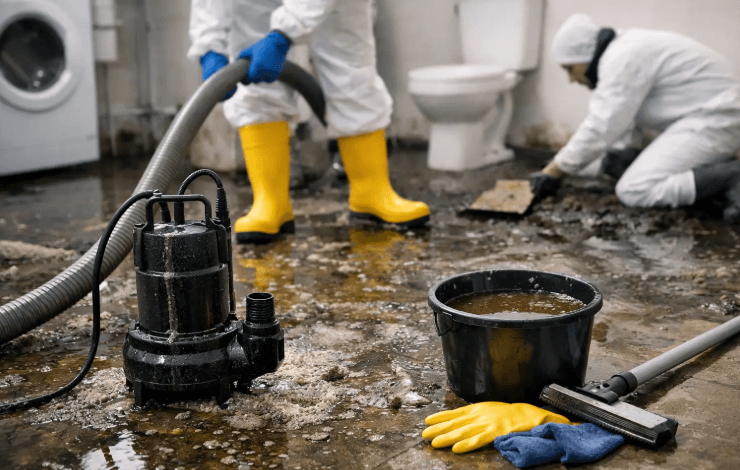
A shop vacuum moves standing water. It does nothing about what soaked into the pad, the tack strip, the bottom plate and the cut edge of the drywall. Carpet pad drinks that water and holds onto it, and bleach wiped across the surface never reaches an inch deep into foam. Restoration crews call this category three water, meaning water carrying human waste, which has to be handled as a biohazard rather than as a spill.
The rule on porous material is not negotiable. Soaked carpet, pad, and the wet lower band of drywall come out of the house, and they are never dried in place. Every hour that family spent pushing a mop around moved contamination further under the baseboard, which is why their eventual bill included drywall that would otherwise have stayed.
Extraction And Sanitizing Are Different Jobs
Extraction deals with the water. Sanitizing deals with what the water left behind. The sequence a septic cleaning Lacey WA crew follows is removal first, then treatment of the slab, framing and cut edges with an antimicrobial, then odor as its own separate step, because a deodorized room that is still damp will smell again inside a week.
People and pets stay out of the affected area the whole time, without exception. Anyone who does go in wears gloves, boots and eye protection, and washes up before touching food or a phone. Skipping the treatment step and going straight to a scented fogger is the most common shortcut, and it buys about ten days of quiet before the smell returns.
Drying The Structure Cost Less Than Rebuilding It
Drying is the step homeowners cut first, and it is the one that decides whether framing has to come out three months later. Air movers and a dehumidifier pull moisture out of wood and concrete on a measured schedule, with readings taken daily until the material reads dry on a meter instead of feeling dry to a hand. How much of the lingering odor sits in the pad versus in the sill plate is something I cannot pin down, and I have never seen anyone measure that cleanly on a residential job.
The arithmetic is worth walking through, using an illustrative scenario rather than a quote. Say the affected area is 380 square feet. Extraction plus removal and haul off of the carpet and pad on a job that size runs somewhere near $1.10 a square foot, so call it $420, and antimicrobial treatment on the slab and the bottom two feet of framing adds roughly $500. Four air movers and a dehumidifier for five days at about $180 a day comes to $900, with a contaminated disposal fee landing near $150. That totals about $1,970 before a single sheet of drywall goes back, which is how a finished basement of that size ends up in the $2,000 to $5,000 range once the rebuild is included.
Insurance is the part nobody wants to think about while the fans are still running. A piece in The Source from August 2026 pulled together EPA leak estimates showing that gradual failures inside walls and subfloors account for close to 10,000 gallons of wasted water a year in the average home, and it noted that standard homeowners policies routinely exclude damage from that kind of slow deterioration. A sudden backup is a different event from a slow leak, but coverage is never automatic, and what a policy owes varies by state and by carrier, so read your own declarations page and ask the adjuster in writing.
See also: The Role of Regular Updates in Keeping Your Business Tools Reliable
Finding The Cause Stopped The Second Backup
Cleanup without a cause is just a scheduled repeat. On this house the tank had not been pumped in five years and the outlet baffle was gone, so solids had been drifting into the field and choking it. Pumping, a new baffle and a riser to make the next inspection quick came in under the cost of the drying equipment alone.
EPA guidelines on sanitary sewer overflows spell out what is actually in that water, listing bacteria, viruses, protozoa, intestinal worms and molds, which is why the rule never changes on these jobs: nobody re-enters the space until it has been professionally cleaned and dried, and any tool that touched the water is disinfected or thrown out. Raw sewage carries disease causing organisms, full stop. Treat a backup as a health hazard on the first morning and the rest of the decisions get easier.
Make The Cleanup Call Before The Carpet Dries
The window that matters is the first day, not the first week. Material that leaves the house wet is a disposal line item; material that dried with sewage in it becomes demolition plus an odor nobody can locate six months later. This family spent three days with a shop vacuum and then paid for the same cleanup they could have had on Saturday, minus the drywall they lost in the meantime. If an inch of it is on your basement floor, get everyone out of the room, leave it alone, and call someone who does this work for a living.