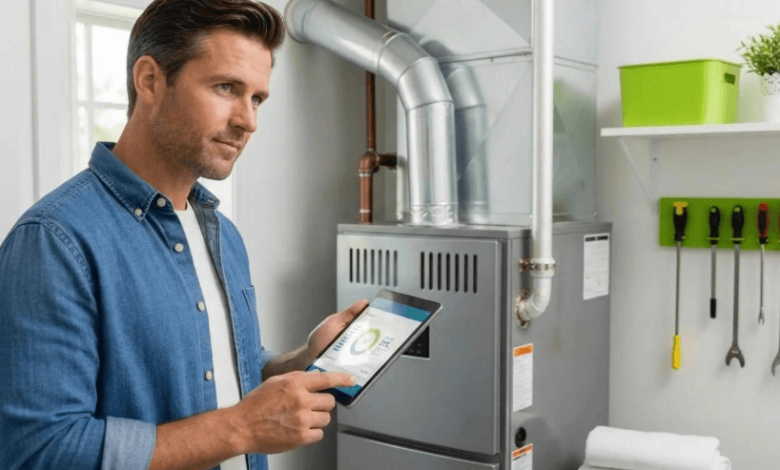
Pressing the reset switch on a furnace that just quit feels like the free fix. It is usually the most expensive move a household makes all winter. A single service call, the kind people search for as furnace repair tumwater wa, costs less than a week of resets that keep firing the same failed ignition into the same worn parts. That is the whole argument. The household this is written for is in its first winter with gas heat: a 1996 80 percent furnace, three lockouts on a 28-degree November night, and a hallway that smells faintly of gas by the third try.
Repeated Resets Hide What Locked the Furnace Out
A gas furnace does not simply stop. It runs an ignition sequence, waits to confirm that flame actually proved, and after a set number of failed attempts it shuts itself down on purpose. That lockout is a safety feature, not a breakdown. The control board records what failed, and it keeps a better diary than anyone else in the house.
Hitting reset restarts the sequence at zero. Once is reasonable. Three times in one evening means the original fault, usually a dirty flame sensor or an igniter that has finally given up, is still sitting there while the equipment keeps trying to light through it. Three lockouts in one night is a diagnosis waiting to be read, not a switch waiting to be flipped. The call we take most often in November is not the first lockout of the season, it is the third one, placed around nine in the evening by someone who has already been up and down the basement stairs four times.
How much of that stored history gets wiped before a technician ever sees it, I honestly cannot tell you. Nobody tracks that number, and every dispatcher I have asked has a different guess. What I can say is that a board still holding its recent fault codes turns an hour of guessing into about twenty minutes of testing.
A Gas Smell Ends Troubleshooting Immediately
Natural gas has no odor of its own, so utilities add mercaptan, the sulfur compound behind that rotten-egg smell. If you smell it anywhere near a furnace, the troubleshooting is over. Washington State Patrol’s heating safety guidance is blunt about what happens next: leave the building immediately, do not touch switches or lights on the way out, and call 911 once you are safely outside. Do not relight the furnace, and do not open the burner compartment to look.
Get everyone out of the house first, then make the call from the neighbor’s driveway. The furnace can wait a night; a gas leak cannot wait ten minutes.
After that, the appliance stays off until a qualified technician has checked it, combustion and heat exchanger included. A cracked heat exchanger can push carbon monoxide into the same air the blower is moving through the ducts, which is why a working CO alarm on every level belongs in any house with gas heat. Rules on who may perform gas work, and on what has to be tagged or shut off, vary by state, so ask the technician what the local requirement actually is instead of assuming.
See also: The Role of Regular Updates in Keeping Your Business Tools Reliable
One Diagnostic Visit Beats a Week of Resets
Money is what keeps most people cycling that switch, so put rough numbers on it. Say a diagnostic call runs somewhere in the $100 to $175 range locally, with parts on top if the sensor or igniter needs replacing; treat those as illustrative figures rather than a quote, because yours will land somewhere else. Compare it with a week of relights through a cold snap, an igniter that finally shatters at two in the morning, and an emergency rate to swap it. Before booking anyone, Washington’s Labor and Industries ‘Verify a Contractor’ lookup is free and confirms a license in about a minute.
The other question that surfaces on these calls is whether to replace a 1996 furnace with a heat pump, and the honest answer leans more on the ductwork and the electrical panel than on the weather. For what it is worth, a July 2026 study covered by pv magazine found residential heat pumps holding a coefficient of performance between 2.24 and 2.97 through the coldest periods, at median compressor speeds of only 29 to 35 percent, so they were nowhere near their limit when the temperature dropped. That is a replacement conversation, though. On the night the heat quits, it is not the question in front of you.
Searching furnace repair tumwater wa at nine at night and booking the visit is the cheaper path, and it is cheaper on the first evening rather than the fourth. One technician reading the lockout history and testing combustion ends the cycle for good. Four resets only postpone it, and if there is ever a smell of gas in that hallway, nothing about this waits: everyone walks out, and the call to 911 happens from outside.